Joe Nallen
I am a communications professional with experience across Stanford, Harvard, Tufts, and mission-driven research organizations.
Core to my work is a commitment to translating evidence-based research into meaningful conversations that drive action and protect vulnerable communities and vital resources.
Professional Interests
Stanford
Assistant Director of Marketing
January 2024 – Present
I develop integrated marketing and communications for the Stanford Graduate School of Business' Admissions Office, working across social, email, web, video, and print assets. I launched and grew the Admissions social channels into core platforms for prospective student outreach, engagement, and application guidance, while also supporting outreach promotions, newsletters, and email nurture campaigns for prospective students.
Core Skills & Focus areas
Project 1
Social Media Graphic Design
Visual content systems + branded templates + campaign graphics.
Social Media Graphic Design
Visual content systems + branded templates + campaign graphics.
OVERVIEW
Stanford GSB Admissions’ Instagram and LinkedIn channels were created to share essential admissions information and showcase the MBA and MSx experience through clear, engaging, brand-aligned content. The overall visual identity of Stanford GSB Admissions' social media channels is designed to be professional, informative, and motivational.
My Role
In October 2024, I launched Stanford GSB Admissions’ first social media channels on Instagram and LinkedIn,
establishing new platforms to connect with and inform a global audience. I currently lead the channels' content
strategy and visual direction, creating recognizable, bold, and reusable layouts, templates, iconography, color
palettes, and typographic systems.
To support information-dense admissions content, I design clear, consistent multi-page templates with strong color
and typographic hierarchies, ensuring clarity, accessibility, and ease of navigation, while remaining fully aligned
with Stanford and GSB brand standards.
I continue to develop new content series and templates (for both static and video-based posts), and am responsible
for measuring content performance on a monthly basis via comprehensive data reports.
General Announcements
Series
Standalone posts highlighting key admissions milestones, designed for immediate clarity and a celebratory tone.
Example Below: Round 1 Admit Welcome
Ask Admissions
Series
Posts that answer common applicant questions directly from the Stanford GSB admissions team to demystify the
application process. Designed to communicate with clarity while maintaining a trusted, approachable tone.
Example Below: “What Does the Ideal Stanford GSB Candidate Look Like?”
Ideas that Changed the World
Series
Framing the school’s legacy of innovation through notable alumni achievements. These graphics are designed to
be visually striking while balancing text-heavy content with boldness. The series is intended to inspire and
engage prospective students.
Example Below: Ideas that Changed the World: Roelof Botha, Eugene Jarvis, Mary Barra
GSB in a Word
Series
GSB in a Word is a series I launched to showcase the Stanford GSB experience through a creative lens, inviting
students and alumni to distill what the community means to them into a single word.
Example Below: GSB in a Word: Phuthi Tsatsi, MBA ’24
Event Graphics
Campaigns
Branded graphics promoting global, regional, and virtual admissions events. Each design balances location-specific
visual cues, essential event information, and a clear hierarchy to support awareness and registration.
Example Below: Stanford GSB Admissions Event Promotion
Design Software Used
Project 2
Custom Coded Email Templates for MSx
HTML email development + responsive design + brand implementation.
Custom Coded Email Templates for MSx
HTML email development + responsive design + brand implementation.
Overview
Clear, consistent, and informative messaging is often our entry point for engaging prospective students, the primary audience for our marketing efforts. It’s important that these emails effectively communicate important information while maintaining the polished identity of the GSB.
When I started my role at Stanford GSB, the MSx Program was still using older email templates that closely mirrored the MBA emails. It was clear the layouts needed an update. The content was dense, hard to scan, and not well suited to how readers actually engage with email.
My Role
Below are custom-coded email templates I designed for the MSx Program, including those used for event announcements and monthly newsletters. These are regularly sent to global audiences of up to 62,000 recipients. The general layout and structure was developed using mock-ups I made on Figma. The templates themselves were built using HTML and CSS, then uploaded to our Slate messaging database so colleagues across our department could use them whenever necessary.
I set up to design more clear content hierarchies, refine the usage of color and fonts, and ensure that the templates were optimized for flexible layouts (especially mobile devices, which were prone to formatting glitches in previous versions). Not only was my redesigned email more streamlined, it clearly differentiated the MSx program from the MBA while remaining cohesive within the broader GSB brand.
The resulting designs extended beyond email, as well. Since launch it has served as a reference point for MSx-specific web, print, and other branded materials. The usage of the design elements across a variety of media has helped establish a strong and consistent external visual identity for the program.
Stanford MSx Email Templates
Examples Below: MSx monthly newsletter; MSx event email. Download PDF of both templates here.


Design Software Used
Project 3
Program Brochures
Editorial design + print production + recruitment collateral.
Program Brochures
Editorial design + print production + recruitment collateral.
Overview
GSB Admissions brochures provide a concise overview of our MBA, MSx, and Deferred Enrollment programs. They're designed for both online and in-person use, and highlight key information for prospect students (i.e. program offerings, class profiles, and next steps for applying).
The brochures also give more detail on academics, community, and our post-graduation network.
My Role
I lead the visual design and layout for the brochures featured below. I created them in Adobe InDesign and used styling that is in alignment with Stanford and GSB brand guidelines.
I wanted to establish clear content hierarchies, use color to highlight and differentiate key information, and ultimately maintain a professional look and feel.
I make periodic updates to the brochures throughout the year as information changes or new information is released.
Since these brochures are also published to the GSB Admissions website, accessibility is a core consideration in this work. All layouts and color palettes are developed to meet WCAG-aligned contrast and accessibility standards for both print and digital formats.
MSx Brochure


MBA Brochure


Deferred Enrollment Brochure


Design Software Used
Harvard
Design & Creative Consultant
October 2024 – Present
Lead digital designer for Harvard research initiatives and the Hum Sab Ek traveling exhibition at the Lakshmi Mittal and Family South Asia Institute. My work spans climate resilience and global health, with a focus on creating impactful visual narratives and interactive experiences. In this role, I work directly with Harvard research faculty and Harvard Graduate School of Design affiliates.
Core Skills
Project 1
Hum Sab Ek
Exhibition systems + digital curatorial companion + multilingual UX.
Hum Sab Ek
Exhibition systems + digital curatorial companion + multilingual UX.
Overview
Hum Sab Ek (We Are One) is an immersive, research-driven traveling exhibition
developed in collaboration with the Lakshmi Mittal and Family South Asia
Institute at Harvard University.
This exhibition is inspired by the actions of poor working women in India, who have survived societal and state indifference through half a century of relentless organizing. Hum Sab Ek Hai (We Are One) is the rallying cry of the nearly 3 million strong Self Employed Women’s Association, thriving at the confluence of the labor movement, the cooperative movement, and the women’s movement.
The installations are based on research comprising 30 hours of oral histories and a survey of over 1000 households, examining the impact of the pandemic on the lives of the poor.
Hum Sab Ek has been shown at:
- Harvard University (Cambridge, MA)
- The Clinton Global Initiative (New York, NY)
- The World Bank Headquarters (Washington, DC)
- Johns Hopkins University (Washington, DC)
- The International Labour Organization (Geneva, Switzerland)
The exhibit will continue its worldwide travel in 2026, with stops in California, New Delhi, and Ahmedabad.
My Role
I served as the primary designer responsible for translating research and curatorial content
into public-facing digital exhibition experiences.
I designed and built the exhibition's digital companions, which includes a 15+ page website (still in development) and mobile curatorial notes translated into Spanish and French. The translated curatorial notes are accessible via QR codes on each panel in the exhibit.
Prior to this, I designed
exhibition signage and visual assets adapted for different physical spaces and displays. I also designed the exhibition logo and beta website, which were shared at large academic conferences and used for fundraising efforts, exhibition applications, and editorial coverage.
In addition to hands-on creation, my consultancy involved providing design direction, constructive feedback, and creative expertise in service of curatorial goals. This work requires close collaboration with faculty, researchers, and design teams across Harvard.
DESIGN SOFTWARE USED
Project 2
Climateverse
Web design + information architecture + hierarchy system for climate research.
Climateverse
Web design + information architecture + hierarchy system for climate research.
Overview
Climateverse is a Harvard-led research initiative that brings together fragmented climate
data to support evidence-based decision-making in South Asia.
The
project organizes complex data sources into an accessible
framework for researchers, helping them better understand
regional climate impacts while addressing challenges around data usability, privacy,
and capacity.
My Role
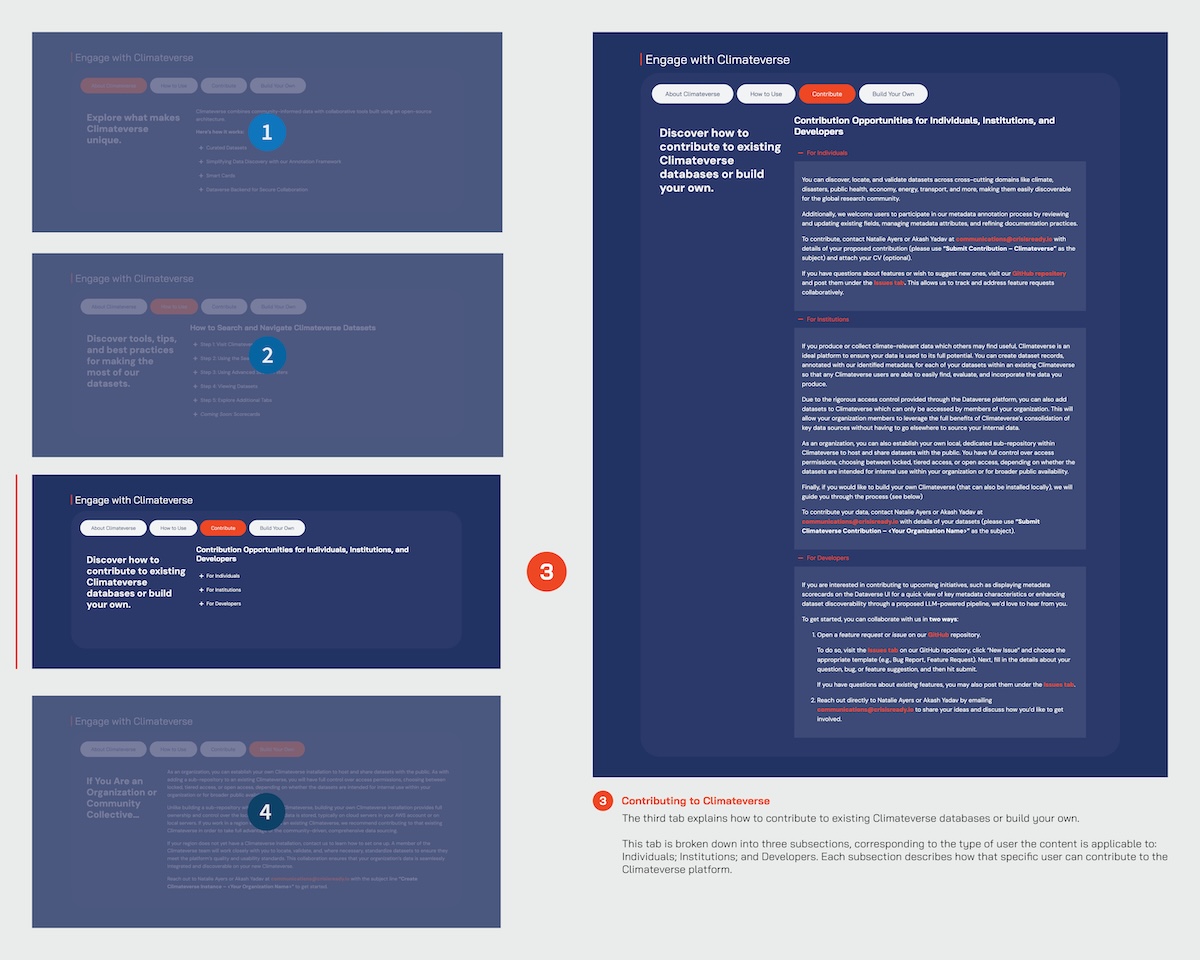
I led the design and layout of Climateverse's primary public-facing landing
page, shaping how the project's research, goals, and data framework are
communicated to external audiences. I was fully responsible for the visual
design, information architecture, and content structure of this page.
Working
with Drs. Caroline Buckee, Satchit Balsari, and Andrew Schroeder, I
organized technical material into a cohesive narrative that guides users
through the project's purpose, methodology, and proposed impact.
The final
design functions as both an introduction to the research and a navigational
entry point for future tools and datasets.
Climateverse Webpage Design
The pages below outline the design and content architecture for the Climateverse webpage. Download a PDF of the document here.



Design Software Used
Research Communications Manager & Creative Lead
November 2021 — January 2024
Working alongside research faculty at Harvard and senior leadership at Direct Relief, I led the design and communication of crisis response research, disaster situation reports, climate and public health research, producing visual systems, data stories, event materials, funding materials, presentations, and long-form publications that made data analyses useful for policymakers, global practitioners, and the public.
Core Skills
Project 1
2023 CrisisReady Annual Report
Art direction + editorial writing + long-form publication design + data
visualization.
2023 CrisisReady Annual Report
Art direction + editorial writing + long-form publication design + data visualization.
Overview
CrisisReady, a research response platform at Harvard University and Direct
Relief, operates at the intersection of climate resilience and public health.
The 2023 Annual Report served as a critical tool to communicate our team's
mission, research, and impact to a global audience of policymakers, humanitarian
practitioners, academic leaders, and lay audiences.
The goal was to
transform dense scientific research into an inviting and accessible narrative
that would drive engagement and support future funding.
My Role
I served as the designer and writer for this project, leading the full conception, narrative structure, and production of the 70-page publication documenting the program's research and global impact. I wrote and edited the report's content in close collaboration with faculty and researchers, translating technical work into clear, accessible language for academic and policy audiences.
I created the complete visual system for the report, including layout, typography, color, and data visualizations. I also managed review cycles with principal investigators, and prepared final files for digital and print distribution. The report was shared at COP28, Harvard leadership briefings, humanitarian convenings, and in funding and grant efforts.
DESIGN SOFTWARE USED
Project 2
2022 CrisisReady Annual Report
Editorial design + visual systems + research synthesis.
2022 CrisisReady Annual Report
Editorial design + visual systems + research synthesis.
Overview
The 2022 CrisisReady Annual Report documents a year of research and
programming on emergency preparedness and disaster response. Focus spans the response and preparedness to natural
disasters across the world, the analysis of refugee displacement during the war in Ukraine, wildfire
relief in California, data privacy initiatives, and collaborations with public
health and government partners.
Designed as a public-facing resource, the report brings together
research findings, trend analyses, and new digital tools to support practical
decision-making in crisis response.
My Role
As was the case for the 2023 report, I served as the writer, designer, and creative lead for the publication,
overseeing the project from concept through final production.
My work was consistent with the following year's project:
I wrote the report's content and developed its narrative structure and
visual system (i.e. layout, typography, color, various data-heavy
visualizations. I worked closely with researchers through iterative review
cycles and prepared final files for digital and print distribution.
DESIGN SOFTWARE USED
Project 3
The Use of Human Mobility Data in Public Health Emergencies
Report design + editorial layout + digital publishing.
The Use of Human Mobility Data in Public Health Emergencies
Report design + editorial layout + digital publishing.
Overview
This research white paper synthesizes key insights from a four-part seminar on
the safe, equitable, and responsible use of human mobility data in public health
emergencies, convened at the Radcliffe Institute for Advanced Studies at Harvard
University.
Bringing together experts from academia, industry, law, humanitarian
response, and public health, the report explores how mobility data can inform
decision-making while addressing ethical, legal, and privacy concerns.
My Role
I led the full design and production of the report, developing layouts, color palettes, visual
, and visual hierarchies. copyediting, proofreading, and digital publishing.
I
worked closely with organizers to shape a clear, accessible document that
translates interdisciplinary discussions into a cohesive, public-facing
resource, and managed its digital dissemination to support broad engagement
across research and response communities.
DESIGN SOFTWARE USED
Project 4
Visualizing Care in the World's Largest Mass Gathering
Data visualization + information design for peer-reviewed research.
Visualizing Care in the World's Largest Mass Gathering
Data visualization + information design for peer-reviewed research.
Overview
Below are three figures I designed for a peer-reviewed public health publication. Design was focused on legibility and hierarchy.

Using Peer Benchmarking to Nudge Safer Antibiotic Prescribing
By embedding peer comparison and decision support directly into clinical workflows, lightweight digital tools can shift prescribing behavior at scale without increasing provider burden.
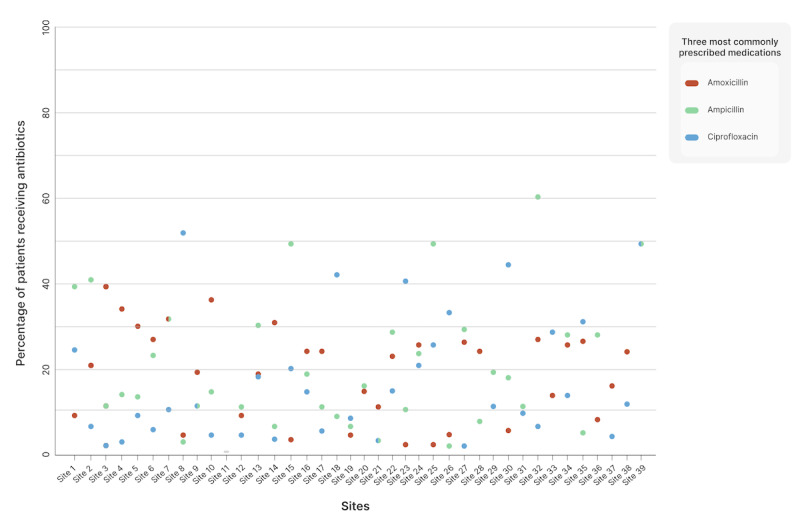
Antibiotic Prescribing Lacks Consistency Across Providers and Sites
Prescribing practices vary dramatically across providers and sites, with some clinics prescribing broad-spectrum antibiotics for more than half of patients presenting with upper respiratory symptoms.

Antibiotic Use Varies Sharply by Clinical Presentation
Antibiotic prescribing rates by syndromic presentation reveal widespread use for upper respiratory tract symptoms, despite strong evidence that most such infections are viral.
My Role
For a peer-reviewed publication in JMIR Public Health Surveillance, I designed
and produced the data visualizations used to communicate research findings on
public health and emergency response.
Working with Harvard faculty
and directly from research data, I translated quantitative information
into clear, accurate visual forms that supported the paper's analytical
arguments and met the standards of academic publishing. I focused on clarity,
precision, and visual restraint, ensuring that each graphic accurately reflected
the data while remaining legible and intuitive for expert audiences.
The visualizations were designed to integrate seamlessly with the
publication's layout and narrative, reinforcing the research rather than
distracting from it.
Key Skills
Project 5
Event Materials
Branded templates and graphics for webinars, panels, and convenings.
Event Materials
Branded templates and graphics for webinars, panels, and convenings.
Overview
My Role
Design Software Used
Tufts
Communications & Design Specialist
May 2019 – November 2021
Led the creative direction and communications for research initiatives at The Fletcher School of Law
and Diplomacy, focused on analyzing the progress of digital innovation across the world, its implementation, and its use in response to the COVID-19 pandemic. This involved translating policy and technology research into accessible visual
narratives, digital experiences, and branded content systems that reached global audiences of
policymakers, academics, and practitioners.
Later, when I transitioned to Fletcher's Central Public Relations and Marketing team, my design work expanded to include the creation of school-wide graphic assets used on websites, social media channels, and in print collateral.
Additionally, alongside the Director of Marketing & Communications, I led our team's content strategy and oversaw the maintenance of the main Fletcher website.
Core Skills
Project 1
Digital Planet
Complete creative rebrand + website redesign + digital experience relaunch.
Digital Planet
Complete creative rebrand + website redesign + digital experience relaunch.
Overview
Digital Planet is a research initiative at The Fletcher School exploring how digital innovation shapes economies, societies, and governance around the world. The project produces flagship research including the Digital Intelligence Index, which benchmarks countries on their digital evolution and trust ecosystems.
My Role
I led the complete creative rebrand of Digital Planet, developing a new visual
identity system and redesigning the website from the ground up. This included
brand strategy, logo refinement, color and typography systems, UI/UX design, and
front-end development oversight.
Add more details about the scope of
work, stakeholder collaboration, technical approach, and outcomes here.
Design Software Used
Project 2
Off the Charts
Editorial storytelling + data visualization + research narratives.
Off the Charts
Editorial storytelling + data visualization + research narratives.
Overview
Off the Charts is a featured editorial section of the Digital Planet website that transforms complex research findings into engaging, accessible stories. Each piece takes a specific insight or dataset from the team's work and builds a narrative around it—combining data visualization, clear writing, and visual design to make policy-relevant research resonate with broader audiences.
My Role
I designed and developed the Off the Charts section, creating the editorial
format, visual templates, and data visualization approach. I worked closely with
researchers to identify compelling stories within their data and translated
technical findings into illustrated narratives that maintained analytical rigor
while engaging non-specialist readers.
Add more details about
specific stories, design decisions, and impact here.
Design Software Used
Education
The University of Texas at Austin
Bachelor of Arts in English Minor in History
2014–2018
Alongside my studies, I built an early foundation in
exhibit design, digital marketing, web publishing,
content strategy, analytics, and information
organization through academic and professional
experiences in Massachusetts and Austin.
I also cross-enrolled in courses at UT Austin’s Moody
College of Communication focused on advertising,
marketing, and applied statistics.
Academic Focus & Early Foundations
Summer 2015
42 | Design Fab
Design Apprentice · Springfield,
Massachusetts
42 | Design Fab
Design Apprentice · Springfield, Massachusetts
Highlights
Completed a design apprenticeship at a full-service exhibit design and fabrication studio. I learned how ideas move from concept to physical form through iterative prototyping, digital conceptualization, fabrication, and assembly. I also contributed to an exhibit installation showcased at the Naismith Memorial Basketball Hall of Fame in Springfield.
Foundational Skills
Apr–Sep 2017
Volusion
SEO Marketing & Writing Intern ·
Austin, Texas
Volusion
SEO Marketing & Writing Intern · Austin, Texas
Highlights
Wrote and published more than 150 pages of content for 40 clients using WordPress and HTML. I also supported social media campaigns for three clients through trend research, audience engagement, and content development. Using Swydo, Google Analytics, and Google Ads, I helped inform campaign strategy and streamline marketing workflows, establishing a foundation in digital marketing, web-based design, and content management systems.
Tools & Skills
Jun–Dec 2018
Khoros
Content Marketing Intern · Austin,
Texas
Khoros
Content Marketing Intern · Austin, Texas
Highlights
At Khoros, formerly Spreadfast, I
produced content about events,
marketing trends, and the company’s
software offerings. I edited and
published content in Drupal, helped
shape summer and fall content strategy,
managed the editorial calendar, and
organized a large library of digital
assets for easier retrieval and more
efficient workflows.
I also used Google Analytics to identify
high-performing content and support a
revamp of the website taxonomy. As part
of that work, I reviewed a year of
digital content and improved the
metadata for more than 100 web pages.
Tools & Skills