
An Economy of Nurturance
Since 1972, nearly four million SEWA members have demonstrated an economy of nurturance by building sustainable livelihoods, establishing microfinance institutions, and influencing policies through solidarity and collective care.
Nearly four million working women in India belong to the Self Employed Women’s Association that began as a trade union in 1972.
Since then, SEWA has organized poor women across India, seeking “full employment” for its members.
Through solidarity, mutual cooperation, and women’s leadership, these home-based artisans, vegetable vendors, junk recyclers, farmers, construction workers, and cooks have started small businesses, established microfinance institutions, influenced domestic laws, and informed international policies.
Their actions have disrupted the structural stranglehold on their lives, providing freedoms that allow them to move towards better futures. The women of SEWA elucidate alternative approaches to preparing us for the intractable challenges that lie ahead.
Celebration of the National Policy for Street Vendors
Ahmedabad, 2004
Street vendors are a familiar feature across India’s urban and rural landscapes, bringing fresh flowers, fruits and vegetables into the hearts of neighborhoods across India. SEWA coined the term Natural Markets for these organically evolving marketscapes that are under constant threat of police harassment and eviction. Since 1995, the International Alliance of Street Vendors with representation from all five continents had been asking governments around the world to draft policies that recognize and protect street vendors. SEWA worked with the National Association of Street Vendors in India (NASVI), and the government, to help draft the National Policy on Urban Street Vendors.
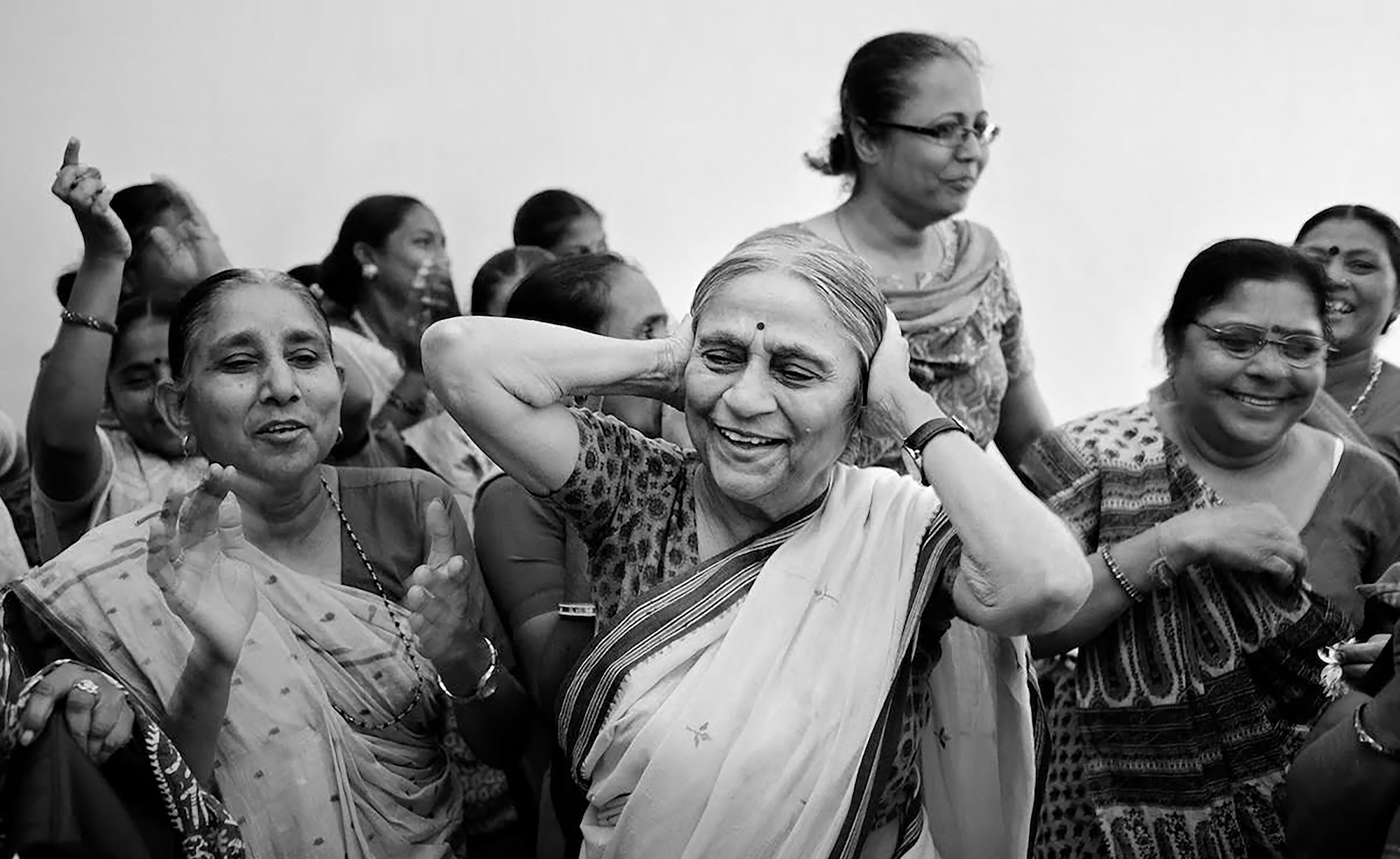
The ebullient photograph above captures the moment when the Policy was finally announced in 2004. Elaben Bhatt (1933-2022), SEWA founder, shares her joy with her “sisters” (bens), Manjulaben Patelia to her left, and Manaliben Shah, now National Secretary of SEWA, in the background and to the right. Elaben noted in her writings that “organizing, the basis of SEWA, is the process by which women come together in solidarity with one another. It strengthens each woman, releases her from her fears and creates bonds of sisterhood across castes, religions, districts, states and even countries.”