Coordinating Pandemic Response Remotely
Smita Bhatnagar, who leads SEWA's Manager Ni School, reflects on the uncertainty at the onset of COVID-19, and how SEWA quickly mobilized remotely to develop preparedness and response strategies.

When the world moved online during the COVID-19 pandemic, the Self Employed Women's Assosciation embraced digital tools to sustain livelihoods, education, health, and solidarity.
For many who had neither owned nor interacted with smartphones, learning to use these seemingly daunting devices became a necessity. Within days of the lockdown, SEWA went online, training its members to use smartphones, create accounts, meet online, administer surveys, and rebuild their networks of solidarity and support.
By the end of March 2020, SEWA launched a digital financial literacy program linking beneficiaries with the formal financial system and access to digital cash transfers that would follow. They uploaded 14 multilingual e-modules and virtually trained 4,188 master trainers across India. By September 2020, 350 zero-percent interest loans were given to street vendors to stabilize their livelihoods, and by December, an additional 1,354 loans with 2.5% interest were disbursed, all of which have since been repaid.
Recognizing that Zoom school was not feasible for the vast majority of children in India, an asynchronous digital program was launched within a week of the lockdown, comprising daily assignments sent over WhatsApp. The children were encouraged to engage with their home environment, explore local histories, participate in household chores, complete school readings, and upcycle waste to make art. The program was called Samay no Samman—Respecting Time.
By March-end, SEWA also launched a telemedicine helpline that had been used by one-third of all surveyed households. Their health app Swasthya Samudaya maintained vaccination logs and tracked reasons for hesitancy. Today, the app provides nudges, reminders, and health education content.
This installation, powered by 338 individual films running in sync across these 77 screens, celebrates the extraordinary digital technology that held societies together as the pandemic ravaged communities around the world. The fragmented display echoes the fractured existence of those uncertain times.
Smita Bhatnagar, who leads SEWA's Manager Ni School, reflects on the uncertainty at the onset of COVID-19, and how SEWA quickly mobilized remotely to develop preparedness and response strategies.
Pruthaben, who supervises education, training, and health programs at the Shantipath Centers in Ahmedabad, focused on supporting mothers and their children during the pandemic. She helped establish daily routines to keep children healthy, engaged, and self-reliant throughout the lockdowns.
Dr. Sahil Hebbar oversees the health and wellness initiatives run by SEWA. He shares how SEWA launched telemedicine, then a mobile application, to help members access timely care during lockdown. He shares how these efforts sparked continuous development of technological care platforms.
BANK ACCOUNTS
JAN-DHAN “KHATAS” EXPECTED BY 2024
Based on data from Pradhan Mantri Jan - Dhan Yojana (PMJDY), 2024
BANK ACCOUNT OWNERSHIP BY
GENDER (ABOVE 15 YEARS)
Based on data from State of India’s Digital Economy, ICRIER, February 2023
SCHOOL CHILDREN
WITHOUT MID-DAY MEALS IN 2020
Based on data from State Survey of School Meal Programs: India, Global Child Nutrition Foundation, 2020
SCHOOL SHUTDOWN WEEKS
(FOR 255.7 M CHILDREN)
Based on data from UNESCO, Reports, Department of School Education & Literacy, Ministry of Education, GoI, 2022
HOSPITAL VACANCIES
FOR NURSING AND ALLIED JOBS
Based on data from Reuters Article, “India builds more hospitals as population surges but doctors in short supply”, 2023
NUMBER OF HOSPITAL BEDS IN SELECT COUNTRIES
AS OF 2021 (PER 1,000)
Based on data from Statista, 2024

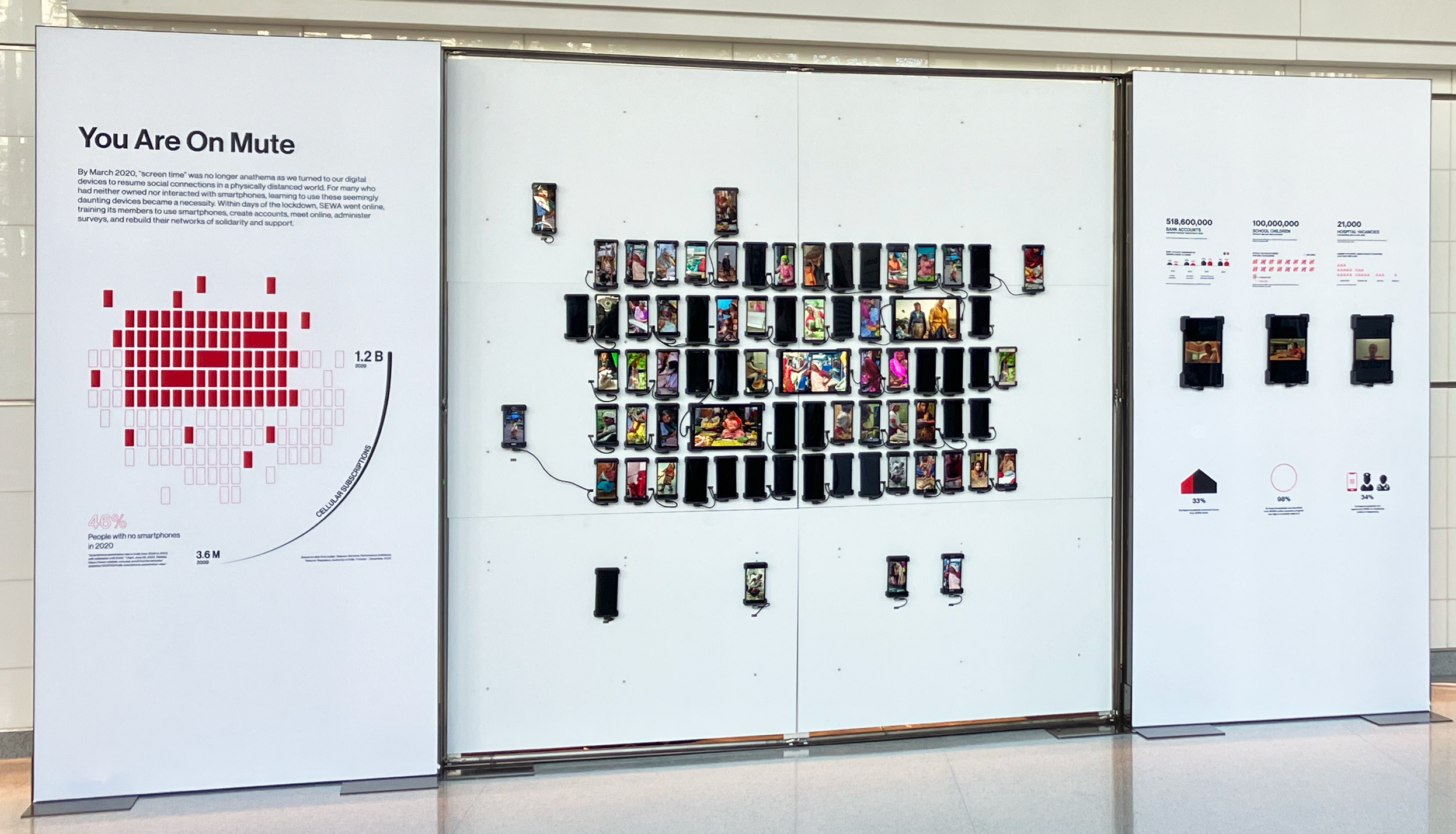
Digital access gap
of people in India had no smartphone, as of 2020
“Smartphone penetration rate in India from 2009 to 2023.” Statista, 2023.
India added more than a billion mobile subscriptions between 2000 and 2020.
Starting point
3.6M
2000
Twenty years later
1.2B
2020
Based on mobile subscription growth data.